

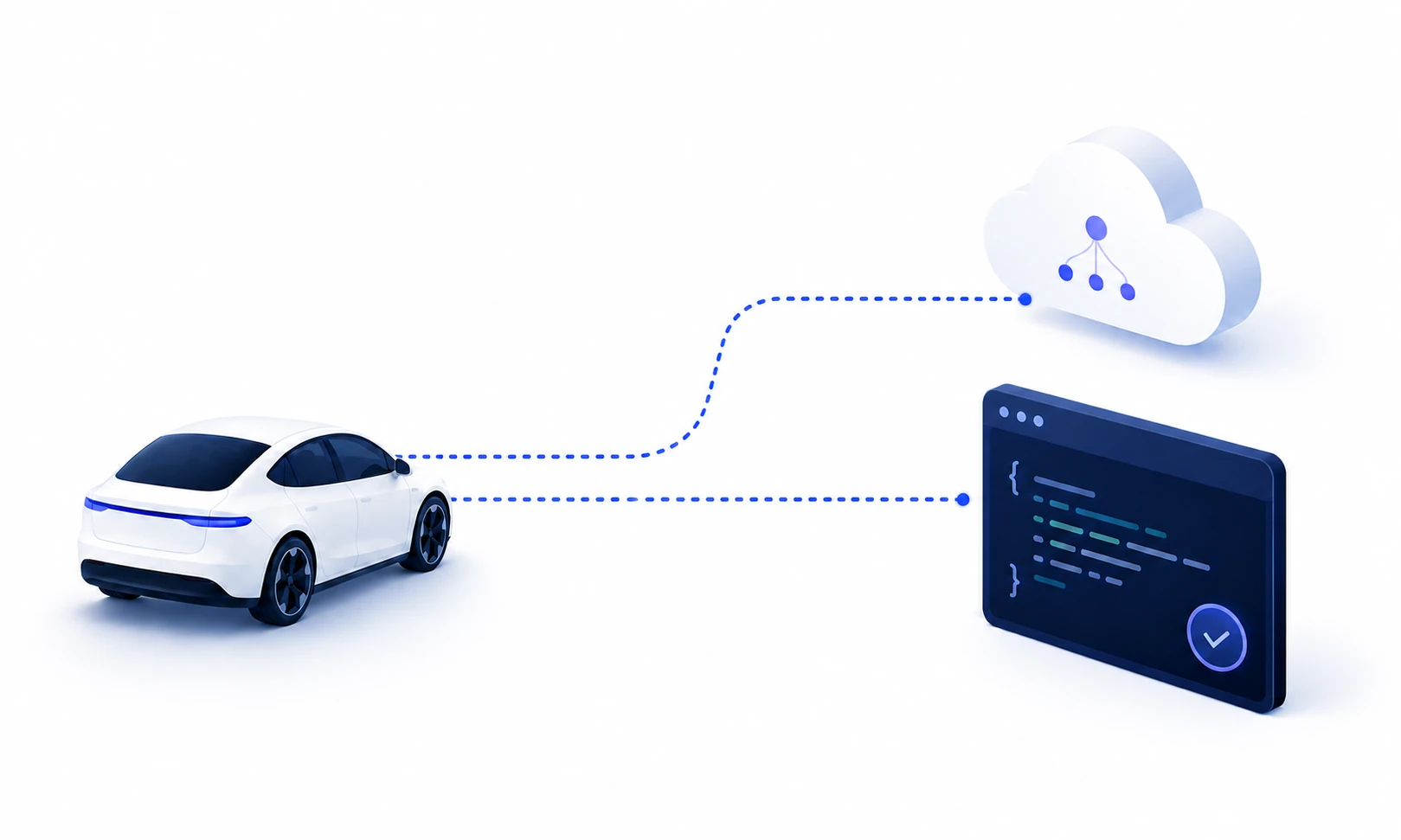
Building with Smartcar is now simpler than ever. In the past, integrations involved managing OAuth code exchanges, orchestrating token refreshes, and building custom polling logic across multiple endpoints. Last year, we started simplifying and stripping away that overhead and began pushing vehicle data to your servers with a revamp of webhooks.
We continue evolving our architecture to favor simplicity and speed, moving toward a data-delivery-first model that lets you focus on building features rather than managing infrastructure.
What we've shipped
- Application Access Tokens: Eliminate the OAuth code exchange and manual refresh cycles. Authenticate and request tokens only when you need them.
- Standardized Signal Schema: A standard list of vehicle signals and attributes across all compatible OEMs.
- V3 Signals API: A streamlined interface to read vehicle data. Pull all signals or a specific signal by code via two unified endpoints.
- Event-Driven Webhooks: Stop polling and start receiving. Let data come to you as it arrives with a simple HMAC check for verification.
What's staying: Connect SDKs
Our JavaScript, iOS, and Android SDKs remain a core part of the Smartcar platform. These tools are purpose-built to handle everything that is needed during the connection flow: OEM sign-in, redirects, Bluetooth pairing, mobile app handoffs, and more. These SDKs are fully supported and remain the recommended way to build a seamless Connect experience.
What's changing: Backend SDKs moving to Maintenance
As we prioritize our V3 direct-access architecture, our Node.js, Python, Java, Ruby, and Go SDKs are moving into maintenance mode, effective immediately. These SDKs will be fully deprecated on December 1, 2026. Until then, they will only receive critical security patches. After that, they will remain published and existing integrations will continue to function, but they will no longer receive any updates, including security patches. Follow our changelog for the full timeline and future updates.
As there is no longer a need to poll Smartcar's APIs or refresh tokens per vehicle, we recommend calling the V3 API directly for commands and data, and verifying webhook signatures with a simple HMAC check.
After December 1st, the backend SDKs will no longer be updated. To move your backend to direct HTTP, follow the steps outlined on this page.
Get Started with V3
Ready to build? Explore our Quickstart guide, dive into the V3 API Reference, or download our Postman collection to start testing today.
