> ## Documentation Index
> Fetch the complete documentation index at: https://smartcar.com/docs/llms.txt
> Use this file to discover all available pages before exploring further.
# Android Tutorial
> In this tutorial, we will use the Android SDK to integrate Connect into your application.
Our frontend SDKs handle getting an authorization code representing a vehicle owner's consent for your application to interact with their vehicle
for the requested permissions. In order to make requests to a vehicle, please use one of our [backend SDKs](/api-reference/api-sdks).
For security, token exchanges and requests to vehicles **should not** be made client side.
# Overview
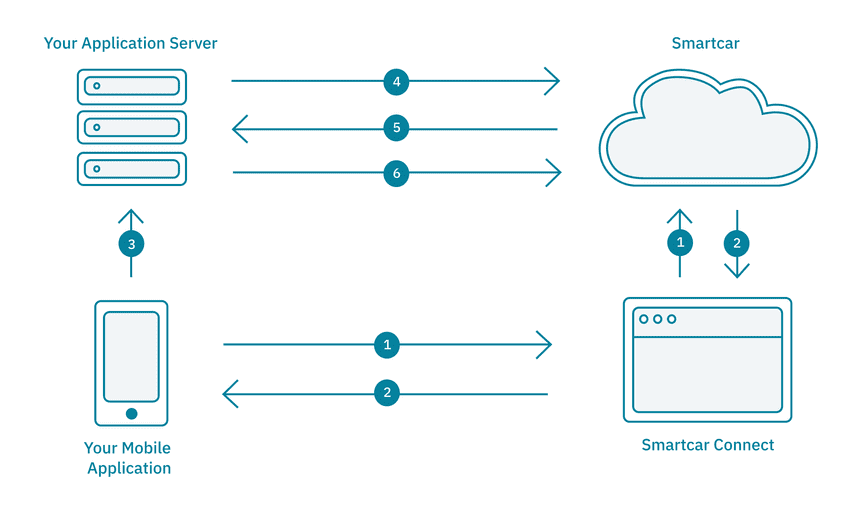
1. The Mobile Application launches a `Chrome Custom Tab` with Smartcar Connect to request access to a user’s vehicle.
On Connect, the user logs in with their vehicle credentials and grants the Application access to their vehicle.
2. The `Chrome Tab` is redirected to a specified `REDIRECT_URI` along with a `user_id` and `state`.
This will be the custom scheme set on the application. The Smartcar Android SDK receives the response in a view listening
for the specified custom scheme URI, and passes it to the Mobile Application.
3. The Mobile Application sends the received `user_id` to the Application’s backend service for storage.
4. The Application’s backend authenticates with the Smartcar API using the [OAuth 2.0 Client Credentials flow](/api-reference/authorization/overview) to obtain an application-level access token.
5. Using the access token and the `sc-user-id` header, the Application can now send requests to the Smartcar API. It can access protected resources and send commands
to and from the user’s vehicle via the backend service.
# Prerequisites
* [Sign up](https://dashboard.smartcar.com/signup) for a Smartcar account.
* Make a note of your `CLIENT_ID` and `CLIENT_SECRET` from the **Configuration** section on the Dashboard.
* Add a custom scheme redirect URI to your application configuration.
* Add the `app_server` redirect URI from [Setup step 2.](/getting-started/tutorials/android#setup) to your application configuration.
For Android, we require the custom URI scheme to be in the format of `sc` + `clientId` + `://` + `hostname`.
For now, you can just set it to `sc` + `clientId` + `://exchange`.
Please see our [Connect Docs](/connect/dashboard-config#redirect-uris) for more information.
# Setup
1. Clone our repo and install the required dependencies:
```bash theme={null}
$git clone https://github.com/smartcar/getting-started-android-sdk.git
```
Do not “checkout from version control” with the Getting Started repo in Android Studio, as it will not open the proper module.
2. Open `getting-started-android-sdk/tutorial` in Android Studio as an existing project and build from existing sources.
Android Studio should automatically import the required dependencies and build gradle. We're setting `app_server` to `http://10.0.2.2:8000`
to pass the authorization `code` from the [Handle the Response](/getting-started/tutorials/android#handle-the-response) step later on in the tutorial to our backend.
```xml strings.xml theme={null}
sc[yourClientId]
[yourClientId]
http://10.0.2.2:8000
```
# Build your Connect URL
1. Instantiate a `smartcarAuth` object in the `onCreate` function of the `MainActivity`.
```java MainActivity.java theme={null}
// TODO: Authorization Step 1a: Initialize the Smartcar object
private static String CLIENT_ID;
private static String REDIRECT_URI;
private static String[] SCOPE;
private SmartcarAuth smartcarAuth;
protected void onCreate(Bundle savedInstanceState) {
...
// TODO: Authorization Step 1b: Initialize the Smartcar object
CLIENT_ID = getString(R.string.client_id);
REDIRECT_URI = getString(R.string.smartcar_auth_scheme) + "://" + getString(R.string.smartcar_auth_host);
SCOPE = new String[]{"required:read_vehicle_info"};
smartcarAuth = new SmartcarAuth(
CLIENT_ID,
REDIRECT_URI,
SCOPE,
true,
new SmartcarCallback() {
// TODO: Authorization Step 3b: Receive an authorization code
}
);
}
```
The Android SDK does not support `simulated` mode at this time - only `test` and `live`.
Feel free to set `testMode` to `false` where you instantiate your `SmartcarAuth` object to
connect to a real vehicle.
2. The Android application will launch a Chrome Tab with Smartcar Connect to request access to a user’s vehicle.
On Connect, the user logs in with the username and password for their vehicle’s connected services account and grants the application access to their vehicle.
To launch Connect, we can use the `addClickHandler` function that our `smartcarAuth` object has access to.
```java MainActivity.java theme={null}
// TODO: Authorization Step 2: Launch Connect
smartcarAuth.addClickHandler(appContext, connectButton);
```
# Registering your Custom Scheme
Once a user has authorized the application to access their vehicle, the user is redirected to the `REDIRECT_URI` with an authorization `code` as a query parameter.
Android applications use custom URI schemes to intercept calls and launch the relevant application. This is defined within the `AndroidManifest`.
```xml AndroidManifest.xml theme={null}
```
# Handle the response
Using the Android SDK, the application can receive the code in the `SmartcarCallback` object passed into the `SmartcarAuth` object.
```java MainActivity.java theme={null}
smartcarAuth = new SmartcarAuth(
CLIENT_ID,
REDIRECT_URI,
SCOPE,
true,
new SmartcarCallback() {
// TODO: Authorization Step 3b: Receive an authorization code
@Override
public void handleResponse(final SmartcarResponse smartcarResponse) {
Log.i("MainActivity", smartcarResponse.getCode());
// TODO: Request Step 1: Obtain an access token
//TODO: Request Step 2: Get vehicle information
}
}
);
```
# Launching Connect
Build your application in Android Studio and click on the **Connect your vehicle** button.
This tutorial configures Connect to launch in `test` mode by default.
In `test` mode, any `username` and `password` is valid for each brand.
Smartcar showcases all the permissions your application is asking for - `read_vehicle_info` in this case.
Once you have logged in and accepted the permissions, you should see your authorization `code` printed to your console.
# Sending the user\_id to your backend
After the user completes the Connect flow, your Android application receives a `user_id`. Send this to your backend service for storage — your backend will use it as the `sc-user-id` header when making API requests on behalf of this user.
```java MainActivity.java theme={null}
public void handleResponse(final SmartcarResponse smartcarResponse) {
final String userId = smartcarResponse.getUserId();
final OkHttpClient client = new OkHttpClient();
new Thread(new Runnable() {
@Override
public void run() {
// Send the user_id to your backend for storage
Request connectRequest = new Request.Builder()
.url(getString(R.string.app_server) + "/connect?user_id=" + userId)
.post(RequestBody.create(null, new byte[0]))
.build();
try {
client.newCall(connectRequest).execute();
} catch (IOException e) {
e.printStackTrace();
}
}
}).start();
}
```
Token authentication should be handled entirely on your backend using the [OAuth 2.0 Client Credentials flow](/api-reference/authorization/overview).
Your mobile app should never handle access tokens directly. The backend obtains a single application-level token
that works across all connected vehicles.
# Getting data from a vehicle
Once your backend has the `user_id` and an application-level access token, it can send requests to a vehicle using the Smartcar API. The Android app will
have to send a request to the backend service which in turn sends a request to Smartcar. We have to do this because
our frontend **does not** have the access token.
Assuming our backend has a `/vehicle` endpoint that returns the information of a user’s vehicle, we can make this query in
our `completion callback` and start another `activity` to show the returned vehicle attributes.
```java MainActivity.java theme={null}
public void handleResponse(final SmartcarResponse smartcarResponse) {
...
// TODO: Request Step 2: Get vehicle information
// send request to retrieve the vehicle info
Request infoRequest = new Request.Builder()
.url(getString(R.string.app_server) + "/vehicle")
.build();
try {
Response response = client.newCall(infoRequest).execute();
String jsonBody = response.body().string();
JSONObject JObject = new JSONObject(jsonBody);
String make = JObject.getString("make");
String model = JObject.getString("model");
String year = JObject.getString("year");
Intent intent = new Intent(appContext, DisplayInfoActivity.class);
intent.putExtra("INFO", make + " " + model + " " + year);
startActivity(intent);
} catch (IOException e) {
e.printStackTrace();
} catch (JSONException e) {
e.printStackTrace();
}
}
```
# Setting up your backend
Now that our frontend is complete, we will need to create a backend service that stores the `user_id` and handles API authentication. Your backend will use the [OAuth 2.0 Client Credentials flow](/api-reference/authorization/overview) to obtain an application-level access token and make requests to vehicles.
You can use any of our backend SDKs below to set up the service.
When setting up the environment variables for your backend SDK, make sure to set `REDIRECT_URI` to the custom scheme
used for this tutorial i.e. `sc + "clientId" + ://exchange`.